
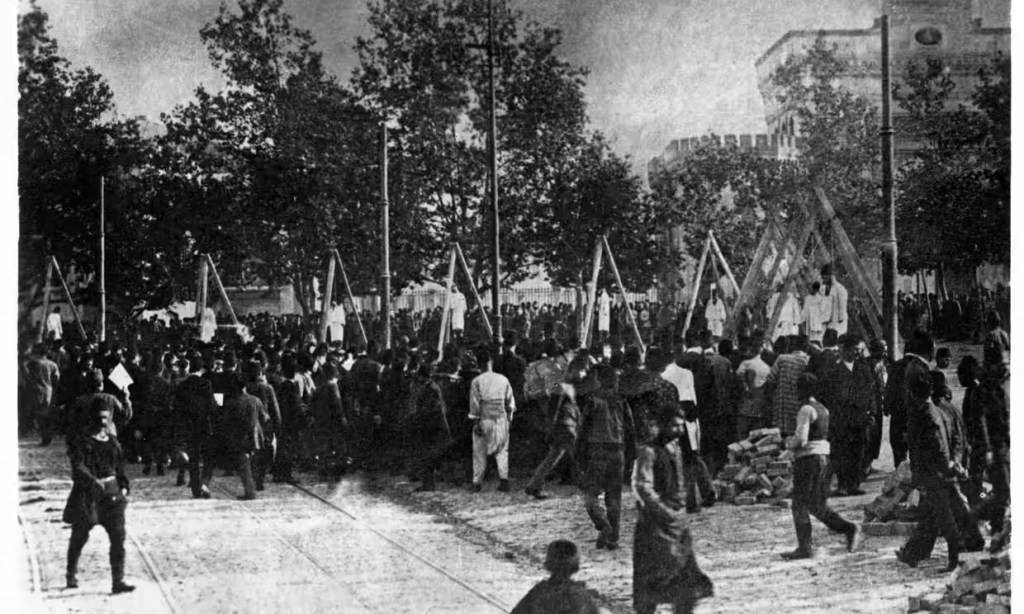
Founded around the year 1300, the Ottoman Empire was one of the mightiest and longest-lasting empires in world history. Though, like all great empires, it eventually met its demise during World War 1. The Ottomans were responsible for the Armenian Genocide as they invaded Armenia so they could advance their military position into the Persian Empire.
Quick facts about the Ottoman Empire:
- The Sultan was the ruler of the Ottoman Empire and commonly had many wives and they all lived together in the Topkapi Palace.
- Janissaries were the elite soldiers that fought for the Ottoman Empire and were selected at a very young age from Christian families.
- In the Ottoman Empire, tulips were the symbol for perfection and beauty.
On June 28, 1914, Austrian Archduke Franz was assassinated and sparked the start of WWI that lasted until November 11, 1918. Remarked as one of the deadliest conflicts in human history, World War I resulted in around 20 million deaths between soldiers and civilians and an additional 21 million extremely wounded. Some of the major battles in WWI were: The Battle of Tannenberg, The First Battle of Marne, The Battle of Gallipoli, The Battle of Verdun, The Battle of Jutland, and the Battle of Somme. The battle between the Central Powers and the Allies ended when Germany signed an armistice, an agreement for peace and to end the war immediately. They did this because they realized there was no chance for them to win the war and wanted to minimize their casualties, thus the Allies won.
Around this time in the early 1900’s, the Young Turk Revolution movement began. The revolution was a political reform movement which is a type of social movement with the goal of making a political system more ideal for the community. The revolution favored replacing the Ottoman Empire’s monarchy with a constitutional government, a government where there is a constitution which will fix principles and is generally accepted as the fundamental law that controls political power. At the time of the revolution, the current Sultan was Abdulhamid II who was rebelled by the Young Turks. The revolution was successful and in result the Ottoman Empire became the Republic of Turkey and the founder was a revolutionary named Kemal Ataturk.
Hovsep Koochagian, born on February 28, 1889 in Khapert Armenia and survivor of the Armenian Genocide, wrote a letter about his story. At a young age, Hovsep and his family were forced out of their home and joined a march to the Syrian desert. His father, who was a respected, well-educated tanner in the village, was taken by the Turks and killed. In his family, three sisters and one brother all died tragically between the ages of 10-12. The remaining members of the family changed their name to Koochagian and emigrated to the USA in 1910 from Canada and settled in Massachusetts to work in a shoe factory.
For over 100 years the Israeli and Turkish government have denied the claims that this was in fact a genocide and that was the accepted truth. Nowadays more than twenty countries consider these immoral acts as genocides and Countries like Austria and Switzerland have gone as far to make this a crime. The recognition of the genocide is a political issue in the US and Turkey is now seen as an ally making the leaders in Washington, DC recognize it. The nation has issued numerous threats of lawsuits and consistently questions academic research into this genocide. Forty-eight states have taken significant steps to recognize the massacre as genocide.



 The Think Tank
Leave a comment