
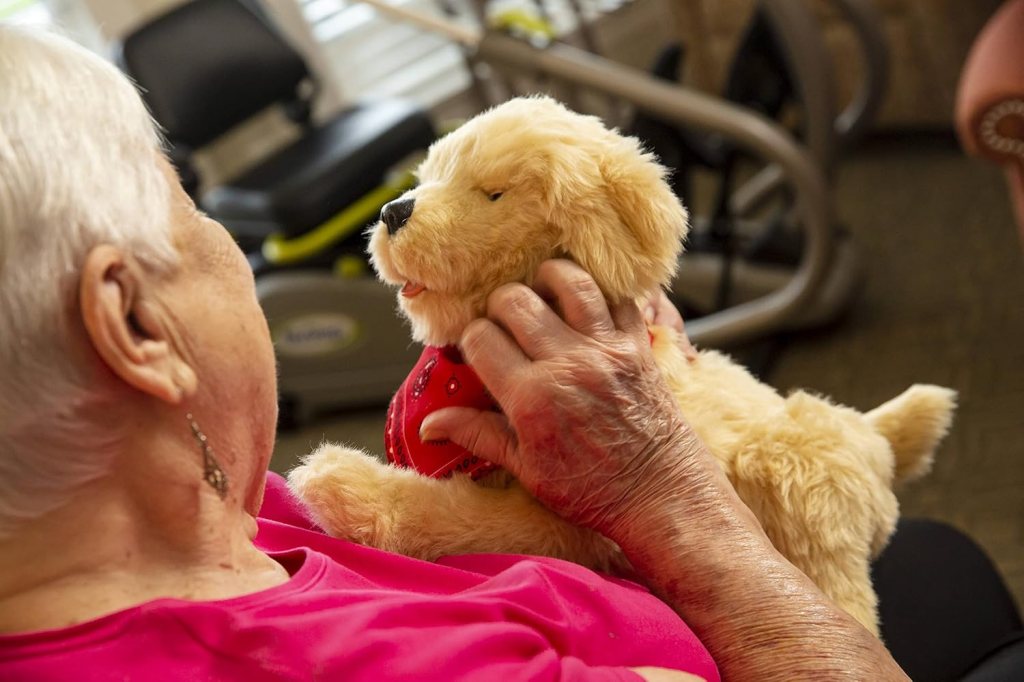
Dementia affects over 55 million people worldwide and commonly causes much more than memory loss. Many patients also experience anxiety, agitation, loneliness, emotional withdrawal, and decreased social interaction. These symptoms can have a major impact on quality of life, especially for residents living in nursing homes and other long-term care facilities.
One possible way to improve emotional well-being among dementia patients is animal-assisted therapy. Live animals can provide companionship, stimulation, and an opportunity for residents to interact with both the animal and the people around them. Previous studies have found that animal-assisted therapy may reduce loneliness and improve emotional engagement among older adults.
However, live animals are not always practical in a nursing home environment. Facilities must consider allergies, infection control, trained handlers, animal care, resident safety, and the fact that some residents may be afraid of animals. These challenges can prevent patients from receiving regular access to animal-assisted therapy.
Robotic companion animals have become a possible alternative. These socially assistive robots are designed to recreate some parts of interacting with a real pet. Depending on the model, they may respond to touch and sound, move their heads or tails, and make realistic animal noises.
Robotic companions do not require food, exercise, veterinary care, or trained handlers. They can also remain with residents for much longer periods of time instead of only being available during a scheduled therapy session.
Previous research involving robotic animals has shown promising results. Studies have reported improvements in loneliness, depression, anxiety, agitation, relaxation, and social interaction. Robotic animals may also act as a social bridge by giving residents something to discuss with caregivers, family members, and other patients.
Despite this, there were still several gaps in the existing research. Many previous studies involved small groups of patients, shared robotic animals, short interaction periods, or self-reported information. Some focused on broad outcomes such as quality of life or general behavior rather than measuring changes in mood across multiple points in time.
Another limitation was that many patients were only allowed to interact with the robotic animal during short scheduled sessions. This does not fully show what may happen when a resident has continuous access to an individual robotic companion. Sharing one robotic animal between multiple residents may also reduce the sense of ownership and familiarity that could develop over time.
This gap led me to conduct a controlled study involving 40 nursing home residents with diagnosed dementia. Twenty residents received individual Joy for All robotic companion dogs while the other twenty continued receiving standard care without robotic dogs.
The residents in the treatment group were allowed to keep their dogs and interact with them whenever they wanted. The dogs responded to touch and sound through movements and vocalizations designed to imitate the behavior of a real pet.
Mood was observed at four separate points. Two observations occurred before the robotic dogs were introduced and two occurred afterward. The same licensed clinician completed all observations using a 10-point mood scale that considered emotional engagement, calmness, responsiveness, and social interaction.
The two baseline scores were averaged and compared with the average of the two post-intervention scores. This allowed the overall change in mood for each resident to be measured.
The treatment group demonstrated an average mood improvement of 0.40 points. The control group had an average decline of 0.075 points, showing almost no overall change among the residents who did not receive robotic dogs.
The difference between the groups was statistically significant, with a p-value of 0.0008. This means that the difference was unlikely to have occurred only because of random variation. The calculated effect size was also considered large according to conventional statistical measurements.
The improvements were not caused by only a few residents. Seventy-five percent of the treatment group demonstrated measurable mood improvement compared with only five percent of the control group.
Although the difference was statistically significant, the average improvement of 0.40 points on a 10-point scale was still modest. Statistical significance does not necessarily mean that an improvement will create a major clinical change. Instead, the results suggest that robotic companion dogs may provide a smaller but still measurable emotional benefit.
There were several limitations to the study. Only 40 residents from one nursing facility participated. Mood was measured using a simplified observational scale rather than a widely validated dementia assessment. The clinician and residents also knew which participants received the dogs, which may have influenced the observations.
Additionally, the exact amount of time each resident spent interacting with the dog was not measured. Some residents may have used their robotic companion much more often than others. Future studies could track interaction time to determine whether more frequent use leads to greater mood improvement.
Future research should also include larger groups of residents, multiple nursing facilities, longer observation periods, and more standardized assessment tools. Other factors such as dementia severity, previous pet ownership, medication use, social withdrawal, and animal preference could also influence how strongly each resident responds.
Robotic companion dogs are not a cure for dementia and should not replace caregivers, family members, or normal human interaction. However, they may provide another source of companionship and emotional support for residents in long-term care facilities.
This study showed how a relatively simple technology may be used to help address a difficult human problem. The devices are not extremely complex, but their value comes from the comfort and interaction they may provide to patients who need it.
Read the full published study here:
This research grew out of a broader effort to bring robotic companion dogs to dementia-care residents. Read coverage of the delivery events here.






Leave a comment