
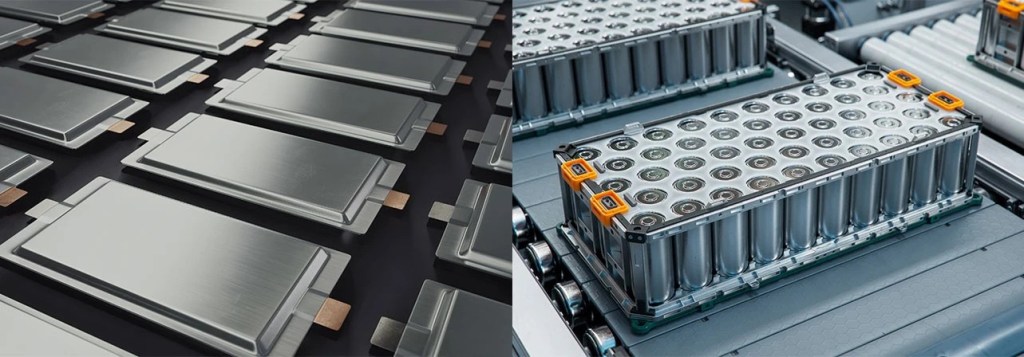
Every day, the demand for the sale of safe, efficient and affordable energy storage solutions is increasing. Solid-state batteries (SSBs) represent a major advancement in energy storage technology and have the potential to overcome several limitations that currently affect traditional lithium-ion batteries. By replacing the flammable liquid or gel electrolytes with solid materials, (including but not limited to ceramics, polymers, or sulfides), solid-state batteries offer much more safety, superior thermal stability, and higher energy densities, which can reach up to 500 watt hours per kilogram (Wh/kg), which is twice as much as current conventional systems.
Solid electrolytes not only enable the use of lithium metal anodes and high-capacity cathodes but also mitigate risks of flammability, dendrite formation, electrolytic decomposition at high voltages, and leaks that would destroy liquid electrolyte-based batteries.
With the ability to withstand twice as many cycles as typical lithium-ion batteries, solid-state batteries also promise longer lifespans. Additionally, their smaller carbon footprint and potential for more compact designs than current lithium-ion batteries make them ideal for newer technologies such as electric vehicles, wearable electronics, medical devices like pacemakers, and aerospace applications. Currently, Asia is leading in global battery innovation, especially in solid-state batteries.
Solid-state electrolytes (SSEs) are the core component of solid-state batteries. They function as ion-conducting solids that would replace traditional liquid electrolytes. This allows lithium (or other metal) ions to be transported between the battery’s electrodes while physically separating the electrodes. This ensures that both ionic conductivity and electrical insulation occur. There are many different types of solid-state electrolytes, each with its own benefits and limitations. Examples include oxide, sulfide, and polymer-based solid-state electrolytes.
Currently, electronics and vehicles account for over 75% of all solid-state battery application research. Other top categories include aerospace, biomedical, and wearables.
Although salty batteries show great promise, several challenges are preventing them from achieving large-scale commercialization. One major technical limitation is the lower ionic conductivity of many solid electrolytes at room temperature compared to that of liquids. In other words, these oxide-based electrolytes require certain temperatures for efficient microstructures, making them complex and costly. Another concern would be electrolyte interfaces. Unlike liquid electrolytes, solid-to-solid contact will often result in poor interfacial contact and high resistance. Chemical reactions at these interfaces can form resistive layers, especially within lithium metal, greatly worsening over cycles and degrading overall performance. The rigidity of solid electrolytes also contributes to stress and gaps during volume changes, increasing impedance and performance decay.
Despite this, solid-state batteries are evolving towards a future where their design, interface engineering, and scalable processing will converge to deliver an ultimately safer, denser, and longer-lasting energy source. The next generation of these batteries will likely feature hybrid and composite electrolytes that would combine the high connectivity of Ceramics with the flexibility of polymers. This would ensure that the interfaces remain stable and that mechanical integrity is conserved during cycling. There are also advancements in low-temperature fabrication, such as cold sintering and transient liquid-assisted processing. This would make manufacturing more efficient and better suited to large-scale production. Some notable prototypes to name would be Chery’s solid-state battery model with an energy density of 600 Wh/kg, targeting a roughly 800-mile range. For comparison, Tesla’s top model, the Model S Plaid, has a Wh/kg ratio of only 181.5 and a range of 360 miles. In a similar fashion, Sunwoda created a polymer all-solid-state battery with 400 Wh/kg and a cycle life of 1200 cycles under extremely low pressure. This could give electric vehicles a hypothetical range of over 600 miles and 1200 cycles. This would solve some of the main problems people have with current electric vehicles, which are range and battery lifespan.
Though the full-scale development may still be many years away, the combination of current scientific and industrial advances indicates that solid-state batteries are on track to significantly reshape energy storage across all industries in the coming decade.




 The Think Tank
Leave a comment