The use of Virtual Reality (VR) in medicine over the last decade has exploded and its impact has been transformative. It offers innovative solutions that enhance patient care and medical training. VR allows one to immerse themselves fully into a setting while making it indistinguishable from the real world. By now many people have experienced VR headsets used in games and simulators, but few have had the opportunity to use VR in perhaps its most significant application—as simulators to real world applications.
VR is an immersive technology through the use of a headset that stimulates an environment. It allows users to interact with the 3D space. VR can create realistic scenarios for training and therapy in a way that is different and more powerful than traditional methods. Sometimes additional sensory equipment is added such as sound, smell, motion sensors and tactile feedback to further enhance the realism of the experience.
Augmented Reality (AR) enhances user experiences by overlaying digital information onto the real world, providing interactive and immersive environments. In medicine, AR assists in visualization during surgical procedures and helps surgeons access critical data in real-time. This improves decision-making and patient outcomes.
Mixed Reality (MR) merges elements of both VR and AR, providing interactive experiences that blend real and virtual worlds. The use of this technology offers significant potential in medical training, allowing learners to safely practice procedures in a controlled virtual environment while perfecting their skill set. Extended Reality (XR) is the umbrella term that encompasses any or all of the immersive technologies (VR, AR, and MR).
At the time of this article there already have been over 4,300 published articles regarding the use of VR in the medical community. It is an application whose use is exploding and revolutionizing medicine.
One such use of VR is in diagnosis simulation. VR platforms simulate medical conditions, allowing physicians to educate patients on a current diagnosis or potential complication in the future. Some examples include macular degeneration, hypertension and brain tumors. For instance, rather than verbally defining what macular degeneration is, a physician could use VR to simulate the changes one would experience while using a VR headset. Allowing one to actually experience a disease state helps illicit lifestyle changes, increase compliance with medical care, and illustrate to patients what they need to look out for. Dr. Spiegel at Cedars-Sinai Hospital published a study that showed how the experimental group that used VR goggles to be educated on the effects of hypertension had long term increased medication compliance and lifestyle changes compared to the control group.
Another study looked at how the use of VR to better explain an elective neurosurgical procedure resulted in a higher rate of physician trust, reduced presurgical patient anxiety as well as increased patient participation when used prior to obtaining informed consent.
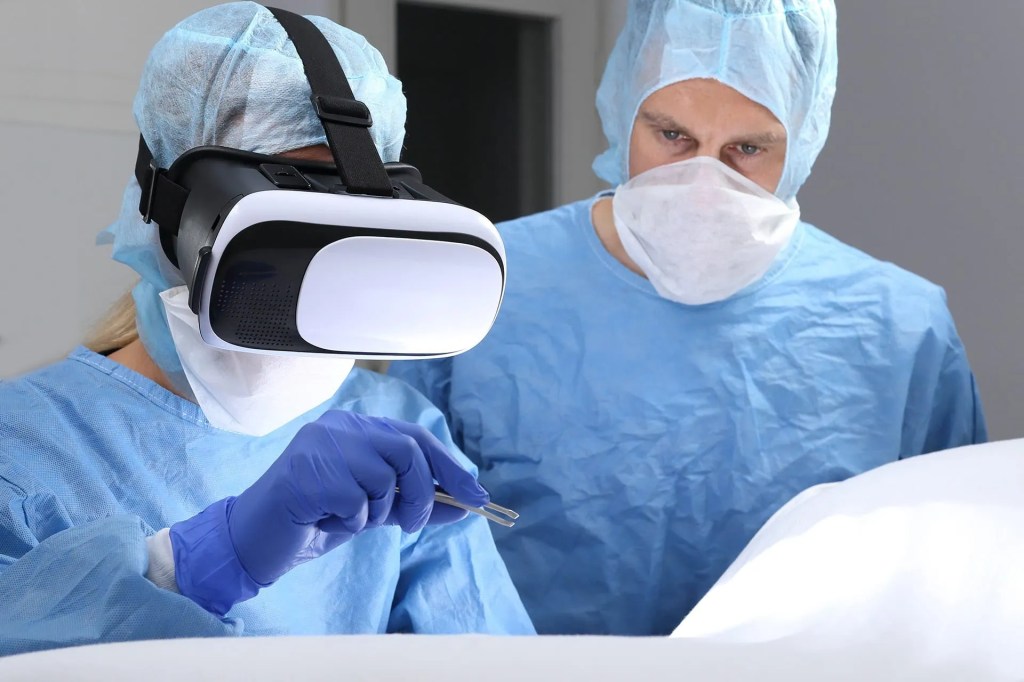
VR is also now being used extensively during medical training. Immersive simulations of learning CPR and running a code as well as performing medical procedures all have VR applications. VR is especially helpful in allowing students to develop skills that require manual dexterity- from applying a central line, to suturing, to performing a laparoscopic surgery. This ultimately leads to increased confidence in students and ultimately better patient outcomes. There are also VR simulations where a doctor in training acts as an avatar in the immersive world and has to interact to make real time decisions in a virtual world full of real-world scenarios. In addition the patient in this scenario can be fully autonomous or played by the instructor.
Many medical schools are now transitioning to using 3D VR for anatomical dissection and learning in place of actual cadaver or as a complementary tool. This allows for more student access, better review, and decreased costs.
The use of VR and AR is not only rapidly changing how surgeons are trained, but how they actually perform their surgeries. The use of AR allows surgeons to receive real-time AI digital guidance as well as collaborate with experts from other locations while they operate. Modalities such as gamified VR physical rehabilitation allow patients to increase engagement and motivation all while improving outcomes. VR use in therapy is particularly beneficial for stroke and post amputation. By allowing the body to “believe” it is functioning as “normal” via VR, recovery times in many instances actually become enhanced.
VR is also an effective tool for healthcare providers with regards to empathy training. It helps clinicians enhance their interactions with patients by simulating real-life scenarios and learn how different actions can lead to different outcomes before actually engaging patients in the real world.
VR is also used in the field of pain management. By using VR to distract patients, providers are able to reduce or eliminate the sensation of pain in their patients. Some common uses include dental procedures, phlebotomy and minor procedures in children.
VR is now widely used in the treatment of mental health issues. It has been proven to help treat anxiety, phobia, PTSD and addiction triggers. It also has been proven effective for meditation and relaxation techniques and improving the quality of life of patients with depression and dementia.
The integration of AI into VR is just starting. In time it will allow personalized experiences and solutions with the end goal of improving patient outcomes and experiences. For instance, Zaya by Cedars-Sinai, is now readily available via the Apple or Google store and is already utilized by thousands on a daily basis. She is a mental health counselor and is one hundred percent AI generated. She has the ability to have actual conversations with patients and render appropriate therapy.
There is no telling where the integration of Virtual Reality and medicine will ultimately lead, but it is abundantly clear that it is here to stay and will forever shape the real world we live in.
Special thanks to my father, Dr. Anthony Barravecchio for giving me virtual access to the OMED 2025 lecture from Dr. Linday Van Dine who is an expert in this field and the main source of the information presented in this article.




 The Think Tank
Leave a comment