
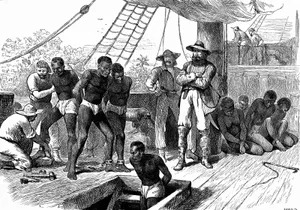
Centuries ago, a triangular trade across the Atlantic, involving Europe, Africa, and the Americas displayed the zero-sum game concept: one can only gain from another’s loss. During the beginning of the Atlantic slave trade in the sixteenth and seventeenth centuries, European and Africans alike forcibly moved around two million Africans from their homes and sold them into slavery. Europe’s economy thrived and they gained a bilateral advantage over Africa, who suffered a parasitical relationship with Europe. Although slave trade deteriorated their economy, Africa’s reliance on European demand for slaves left them stuck with the bilateral disadvantage. The Atlantic slave trade combined Africa’s and Europe’s respective desires to ensure a consistent and maintained supply pattern which contributed heavily to European economic growth. This trade generated large profits for European merchants and caused the rise of a new economy. Europe’s increased demand for cheap labor on American sugar plantations created a large incentive to support the slave trade. On the other hand, Africa’s economy depended on selling slaves to Europe which forced them to continue this trade that was a short-term benefit and a long-term loss. The slave trade provided large profits and great political power for European merchants by constraining the power of the monarchy, causing the rise of capitalism, altering social implications, and contributing to institutional change. The Atlantic slave trade forcibly moved millions of Africans, reshaping the societies, economies, and cultures of Europe, Africa, and the Americas, and left a legacy of social inequality and racial discrimination that still remains today.
Read the full version below:


 The Think Tank
Leave a comment